Hidden Water Leak Detection in Belleville, NJ

Pinpointing water escaping behind walls, under floorboards, and above finished ceilings before damage spreads. Non-invasive diagnostics save your finishes.

Non-Invasive Water Leak Detection in Belleville, NJ

When searching for reliable water leak detection Belleville NJ homeowners can depend on, avoiding destructive exploratory holes in finished surfaces is a top priority. In neighborhoods such as Silver Lake and the Soho section, multi-family homes built throughout the 1920s and 1930s often carry horizontal pipe runs hidden deep inside lath-and-plaster walls. Over time, internal oxidation or joint settling triggers slow seepages that move silently along studs.

Performing hidden water leak detection Belleville properties require means using non-invasive diagnostic sensors that read moisture and sound waves right through surfaces. If you notice a leak behind wall Belleville structure components or discover a high water bill leak Belleville NJ utility notice, accurate pinpointing locates the exact coordinate so your plumber only cuts where necessary.
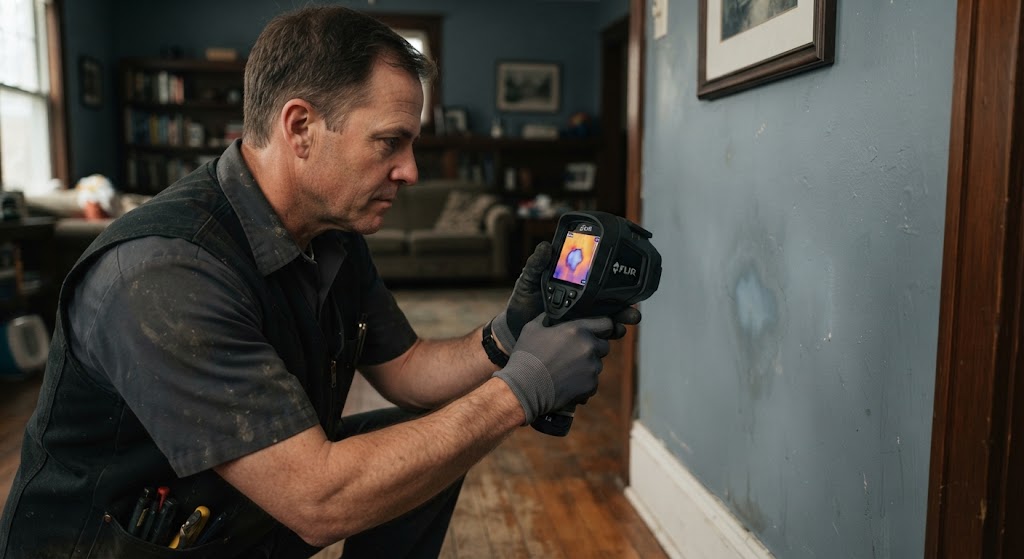
Thermal imaging camera pinpointing hidden water leak detection in Belleville NJ home

Warning Signs of a Concealed Water Leak

Because pressurized plumbing lines operate behind walls and below subfloors, visual water emergence is often the last sign rather than the first. Look for these early alerts:

Rising Water Bills

A steady month-over-month increase in utility charges with no change in household habits strongly points to a continuous micro-leak inside walls or service branches.

Water Meter Active While Fixtures Off

Turn off all internal faucets, washing machines, and ice makers. If the mechanical test dial or digital readout continues to register continuous flow, water is actively escaping.

Damp Drywall & Ceiling Stains

Bubbled paint, soft drywall seams, discolored plaster, or peeling baseboards typically indicate water pooling along structural headers or sill plates.

Persistent Musty Odors

A sour, moldy smell emanating from closed rooms or behind cabinets often points to saturated fiberglass insulation and decaying drywall hidden from sight.

Warm Floor Patches

If tile, hardwood, or basement flooring feels unexpectedly warm underfoot, a domestic hot water supply line running below is actively losing pressurized water.

Hissing Sounds in Wall Cavities

Small pinholes under high water pressure create faint acoustic hissing or rushing sounds that can be heard when the ambient room is quiet.

Noticing any of these signs in your home?

Contact our local team immediately to prevent structural wood rot and pervasive mold contamination.

Call (201) 510-1615

Local Plumbing Factors Causing Concealed Leaks in Belleville

Belleville homes experience specific environmental and structural stresses that accelerate plumbing line failure:

  • Aging Galvanized Supply Lines: Early-century homes throughout the Washington Avenue corridor frequently feature galvanized iron pipes that suffer internal mineral corrosion, leading to thin walls and sudden pinhole blowouts.
  • Copper Pitting Corrosion: Chemistry variations in municipal water and slight electrical grounding currents cause localized pitting in copper tubing over decades of continuous service.
  • Winter Freeze-Thaw Stresses: Harsh Essex County cold snaps freeze uninsulated pipe runs in exterior wall bays or unheated crawl spaces, expanding metal until solder joints fracture.
  • Foundation Settling: Natural ground settlement near the Passaic River basin places mechanical shear strain on copper risers entering through basement masonry.

Safety Precaution Notice

Note on Gas Safety: If you ever smell natural gas (a rotten egg or sulfur odor), do not investigate or operate electrical switches. Immediately leave the building and call your gas utility or 911 from outside. Our leak detection services are exclusively dedicated to potable water and drain networks.

Our Step-by-Step Detection Method

Step 1: Zone Isolation & Pressure Verification

We hook digital gauges up to dedicated fixtures to measure pressure decay across cold and hot potable supply branches, isolating whether the failure is on the pressurized supply or gravity drainage.

Step 2: Acoustic Sound Profiling

Using sensitive acoustic ground listening microphones and frequency filters, our technicians map sound resonance through wood framing, sheetrock, and subfloors to find the acoustic peak.

Step 3: Infrared Thermal Imaging

Thermal cameras visualize sub-surface temperature differentials. Hot water leaks show as expanding thermal clouds, whereas cold water lines reveal characteristic cooling gradients behind wall surfaces.

Step 4: Non-Invasive Moisture Mapping & Tracer Gas

Calibrated radio-frequency moisture meters trace the wet perimeter back to its origin. For elusive micro-fissures, safe tracer gas blends are introduced and tracked with sniffing probes to pinpoint the exact coordinate.

What Happens After the Leak is Found?

Once our detection instruments isolate the exact point of failure, we mark the precise coordinate on the surface. Because the spot is pinpointed to within an inch, your licensed plumber only needs to create a compact, surgical opening rather than dismantling entire walls.

Depending on the condition of your plumbing, repair options typically include:

  • Localized Section Repair: Cutting out the ruptured copper or galvanized segment and sweating in new copper or PEX using transition couplings.
  • Supply Riser Replacement: Bypassing deteriorated wall piping with an updated direct supply run to eliminate recurring pinholes.

Plumbing modifications must be performed by a New Jersey licensed master plumber to ensure code compliance.

Understanding Cost Factors

While repair prices vary based on contractor and materials, total project costs depend primarily on clear mechanical variables:

  • Accessibility: Pipes located behind tiled shower walls or below poured concrete slabs require more specialized access than open wall cavities.
  • Pipe Material & Extent: Replacing an isolated copper fitting is simpler than upgrading an entire corroded galvanized main trunk line.
  • Secondary Structural Damage: The length of time water flowed unnoticed dictates whether drywall drying or framing remediation is required.

Prevention Tips for Belleville Homeowners

Proactive maintenance limits unexpected plumbing leaks:

  • Install Pressure Regulators: Keep domestic water pressure between 50 and 65 PSI. Excessive pressure accelerates copper wall thinning.
  • Insulate Vulnerable Pipes: Wrap foam sleeves on pipes running near exterior walls or unconditioned basements before freezing temperatures arrive.
  • Monitor Water Meters Monthly: Conduct regular 15-minute static meter checks to identify slow hidden leaks before structural staining occurs.

When It's an Emergency

If water is actively cascading through lighting fixtures, causing ceiling plaster to sag, or rising through subflooring, take immediate action:

  1. Shut off your main water valve immediately.
  2. Cut electrical power to wet rooms at the circuit breaker box.
  3. Call for emergency assistance to evaluate and pinpoint the active break.

Visit our dedicated emergency leak repair resource for detailed safety guidance.

Common Neighborhoods & Frequently Asked Questions

Hidden water leaks are particularly frequent in older homes around Belleville Park area and the Soho section, where original piping systems have faced decades of temperature cycles.

How do I know if my leak is behind a wall or under a floor?

Water follows gravity and structural joists, meaning stains on a ground-floor ceiling often originate from second-floor bathroom plumbing several feet away. Non-invasive moisture profiling and acoustic listening trace water flow back to its physical point of origin.

Will leak detection damage my home's drywall or wallpaper?

No. Our detection equipment relies on surface sensors, thermal infrared lenses, and acoustic microphones. No holes are cut during the detection phase.

What should I check before scheduling a hidden leak inspection?

Check your water meter to verify if the leak indicator is moving when all taps are closed, and locate your main water shut-off valve in case an active leak accelerates.

Related Leak Detection Services

Suspecting water pooling in lower levels? Explore basement leak detection. If you suspect broken supply lines outside, learn about our water line leak detection, or return to our overview on leak detection in Belleville and check our service areas.

Call (201) 510-1615
Call (201) 510-1615